
- Dhaka



It Never Rains in Shukhno Gram
In a forgotten corner of the country, at a railway station where rain never falls, a lonely station master's life is disrupted by the arrival of a mysterious woman in blue. What follows is a quiet, romantic tale of chance encounters, longing, and moments that linger longer than expected.
Back in my university days at Dhaka University, studying economics, I never imagined that I’d end up here—at a rundown, inactive railway station in the middle of nowhere. Yet here I was: the station master of what is probably the quietest railway stop in Bangladesh.
They call it Shukhno Gram Rail Station, though the locals jokingly refer to it as Hoogna Geram—a dry, parched land. Why “shukhno” or “dry”? Because it simply doesn’t rain here. I’ve been stationed here for nearly a decade, and I’ve never seen a single drop.
The job has its perks—no office politics, no spreadsheets. Just minor tasks, light paperwork, and rare human interaction. But it’s lonely. The stillness of the village has dried me out too.
One hot May afternoon, a train screeched to an unexpected halt. I frowned. The only scheduled train had passed hours ago. A stop like this meant someone had pulled the emergency handle.
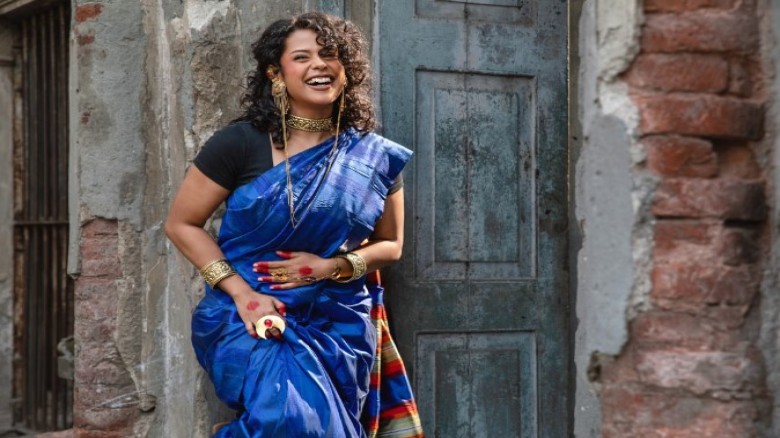
Moments later, a thud, a large suitcase hitting the platform, and then—her. A woman stepped off in a striking blue saree, dabbing the sweat from her brow.
“Excuse me, how do I get to Dhaka from here?” she asked breathlessly, as the train disappeared into the horizon.
I was stunned. Her journey ahead wasn’t simple. Muddy roads, trawlers, and long bus rides just to reach a town.
She sighed, “When’s the next train?”
“Tomorrow. Noon.”
She dragged her luggage into the waiting room and collapsed onto a bench, eyes closed. Resting.
Curious, I looked at her more closely. The rojonigondha on her wrist, the aalta on her fingers, the minimal yet striking jewelry—all suggested a festive occasion. Her blue saree, immaculately draped, clung to her as the sunlight filtered through the old windows.
“Never seen a beautiful woman before?” she teased, still resting, eyes shut.
When she awoke, the evening had turned cool—relatively speaking. No electricity, of course, as usual.
Sipping the tea I handed her, she said flatly, “I ran.”
“Eloped?” I asked, half-joking.
“Ran away from my wedding. It’s in two days,” she replied. “I just kept going until I had to get off somewhere. I’ll go back tomorrow. This was foolish.”
After a long pause, she turned to me, “And why are you here?”
“I told you—I’m the station master.”
She came and sat beside me. “No, I mean really. What’s your story? A decent man like you wasting away here?”
No one had asked me that in a long time.
I told her about my days in DU. How I wanted to study art, not economics. After graduation, while friends pursued corporate dreams, I wandered. I painted. I travelled. That’s how I found this place. I stayed for its peace—the krishnachura trees, the open skies, the stillness. Here, I could paint in silence.
“I want to see your work,” she said softly.
So, I showed her—sketches of the station, of villagers, of a stray dog I’d befriended, and of course, scenes from the endless drought of Shukhno Gram.
She was moved. Shocked even, to learn that it never rained here.
Playfully, she declared, “If it rains before my train arrives, I won’t leave.”
The next morning, golden sunlight hit her face as she leaned against the station wall. Eyes squinting, but smiling.
I dipped my brush into paint, working quickly to capture the moment—her tangled hair, her jewellery, the folds of her saree, the petals in her hand, the deep red aalta.
“You never told me why you ran,” I said.
“Does it matter?” she replied. “Aren’t you glad I did?”
I said nothing.
She told me about her job at a consultancy she hated, her worried family, and how she wore her mother’s saree at a pre-wedding event before running away. But she never said what exactly pushed her to leave.
By the time I finished the painting, her train was approaching.
She looked at the canvas in awe. “You really think I’m that beautiful? Keep it. Put it in a gallery someday and invite me when you’re famous!”
I carried her suitcase to the platform. “Still no rain,” I said.
She laughed. “Told you—you won’t be that lucky. Go home and rest. Your shift’s long over.”
“So, the wedding’s back on?”
She paused. “It didn’t rain.”
The train arrived. She boarded. I turned away and left.
But halfway back, thunder roared behind me.
Rahim, the rickshaw-van driver, stopped. “What’s happening?”
A breeze. Then grey clouds. Then another thunderclap. I yelled, “Back to the station! Now!”
Villagers came out of their homes. Children ran outside. Hope sparkled in their eyes.
But this is Shukhno Gram. Hope is often cruel here.
The clouds cleared. No rain. Just false hope again.
By the time I reached the station, the train was long gone.
I turned to leave, heart heavy.
Then I heard a voice: “Excuse me. I think I missed my train.”
I turned around—and there she was. Smiling.
My bride in blue.
Model: Shababa Rashid
Jewellery: Shoilee by Tahmina Shaily
Wardrobe (Saree): Shoilee by Tahmina Shaily
Makeup: Nur Azmain





















Write your opinion