
- Dhaka



Rising Interest and Subsidy Costs Strain Bangladesh’s Budget
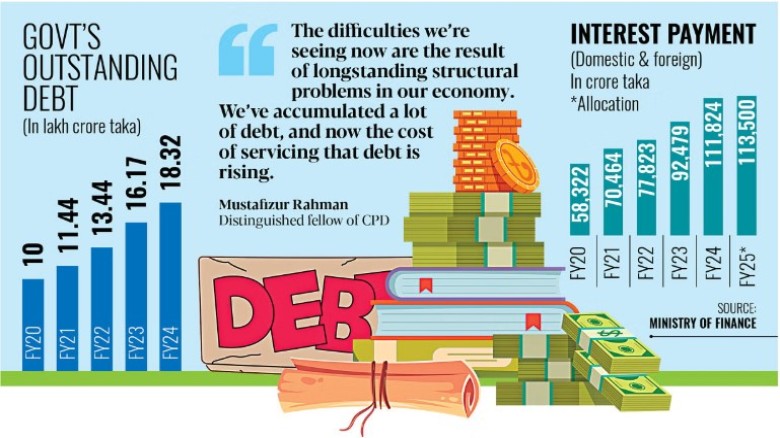
Nearly half of Bangladesh’s national budget spending in the first seven months of FY2024-25 has been consumed by interest payments and subsidies, reflecting growing fiscal pressure. According to the finance ministry, between July and January, Tk 118,046 crore—or around 48% of total expenditure—was spent on debt servicing and subsidies, out of a total budget of Tk 246,583 crore.
Interest payments alone rose by 27% year-on-year, reaching Tk 75,902 crore. The budgeted amount for the full year may need to be revised upward due to rising borrowing costs and currency depreciation. Economist Mustafizur Rahman of CPD noted that the situation stems from structural issues and excessive past borrowing, calling for more prudent fiscal management.
Subsidies also saw a sharp 53% increase, hitting Tk 42,144 crore. Power sector subsidies are likely to overshoot projections, while gas and fertilizer subsidies are also rising. Despite repeated calls from development partners to reform subsidy structures, progress has been slow.
Bangladesh’s public debt grew by 13.3% year-on-year, reaching Tk 18.3 lakh crore—36.3% of GDP—further tightening fiscal space. At the same time, development spending has declined, and revenue mobilisation remains sluggish, forcing greater reliance on domestic and foreign borrowing.
Analysts warn that without urgent reforms in spending efficiency and revenue generation, the country may face a deeper fiscal crisis in the years ahead.

























Write your opinion